Reviewed & Approved by Evan Peter — ISA Certified Arborist (TX-4602A). Evan Peter is the founder of Happy Tree Service of Austin and has spent more than 30 years planting and caring for trees across Austin, long enough to know which species survive a Central Texas summer and which ones only look good at the nursery. He holds ISA Certification, Tree Risk Assessment Qualification (TRAQ), Texas Oak Wilt Qualification (#TOWQ-436), and a Texas Pesticide Applicator License — credentials that place him among the most qualified arborists in the region. Every planting recommendation on this page follows his science-based approach: match the species to the site, plant at the correct depth, and protect the tree for the decades ahead. Happy Tree Service carries a 4.9-star rating across 300+ verified reviews.
Planting a tree in Central Texas involves more than placing a sapling in the ground. Intense heat, clay-heavy soil, and unpredictable rainfall make tree establishment especially difficult without the right expertise. Many well-intentioned efforts fail because of poor timing, inadequate soil prep, or improper species selection.
At Happy Tree Service, we take a science-based approach to tree planting that prioritizes root health, species compatibility, and long-term growth, supported by a trusted Arborist Austin TX team. Our ISA Certified Arborists help you select native trees that thrive in the local climate and install them with care and precision. With every project, we offer guidance on watering and seasonal care to give your new tree the best possible start.
Why Newly Planted Trees Fail in Central Texas
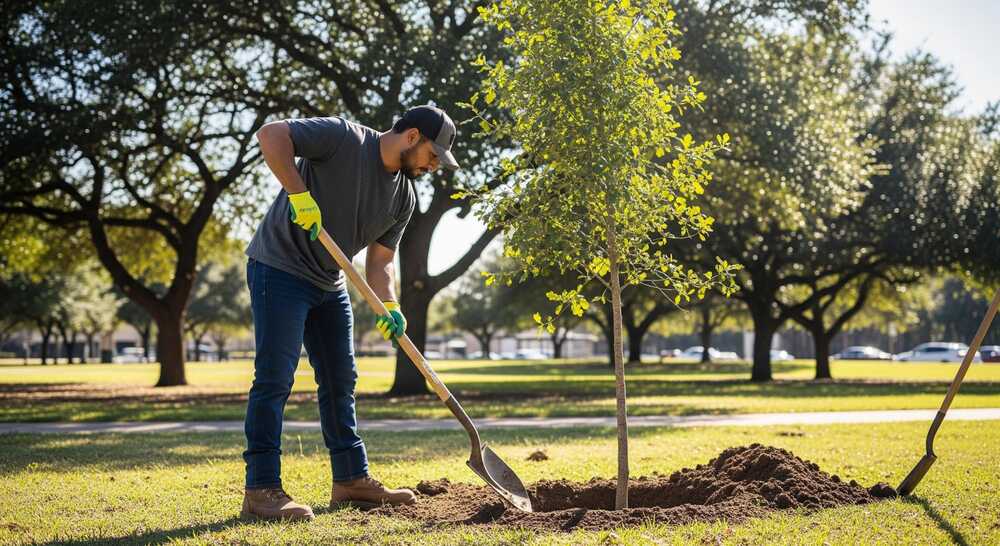
Most newly planted trees in Central Texas fail for three reasons: the wrong species for the site, planting too deep, and too little water through the first two summers. Every one of them is preventable, and every one is decided on planting day or in the weeks right after.
The wrong species is the most common mistake. A tree picked for looks at the nursery, or one suited to the pines of East Texas, rarely holds up in Austin’s alkaline, clay-heavy soil and long summer heat.
Planting depth is the next. A tree set below its root flare, where the trunk widens into the roots, slowly suffocates and rots at the base. The root flare has to stay visible at the soil line.
Water is the third. A new tree needs steady moisture at the root ball while its roots expand, and underwatering during that first hot season is what loses most trees. Our ISA Certified Arborists plan for all three before the first shovel goes in the ground.
How We Plant Trees With Precision: Certified Expertise and Smart Planning
Tree planting is an investment that should deliver lasting value. Our approach is guided by credentials, experience, and the belief that healthy trees begin with informed planning and proper technique.
ISA Certified Arborists on Every Project
Each planting starts with a site assessment by an ISA Certified Arborist. This certification means our team has advanced training in tree biology, soil evaluation, and species-specific care. By assigning certified experts to every planting, we ensure your tree is matched to the right location and installed for long-term success.
Customized Soil and Root Preparation
Many planting failures in Austin can be traced to soil that is too compacted or nutrient-poor. Before we plant, we assess your soil for pH, drainage, and compaction. We improve poor conditions with compost, aeration, and organic amendments that promote healthy root development. Addressing these factors before planting gives your tree a strong start.
Locally-Sourced, Native Tree Selection
We source all trees from trusted local nurseries that grow species adapted to Central Texas conditions. Native trees such as cedar elm, live oak, and Mexican plum are more resilient to heat, drought, and local pests. Choosing locally-grown trees also reduces transplant stress and improves survival rates after planting.
Post-Planting Support and Seasonal Guidance
Once your tree is in the ground, we provide clear instructions for watering and seasonal tree care Austin property owners can depend on. Our team can also schedule follow-up visits to monitor progress and recommend any adjustments based on your landscape’s changing conditions. This support helps ensure your investment continues to grow strong in the months ahead.
Our Tree Planting Process From Start to Finish
Our team follows a proven process that combines science, planning, and hands-on care from the first visit through follow-up support.
Site Visit and Tree Selection
We begin with an in-person consultation to assess sunlight, drainage, soil conditions, and available space. We also consider your goals, such as shade, privacy, or seasonal color. Based on this evaluation, we recommend native or adaptive species that align with your landscape’s conditions and your vision.
Root Care and Soil Prep
Before planting, we evaluate each tree’s root system and correct any root-bound growth. Container-grown trees often develop circling roots that must be loosened or corrected with a professional tree prunning service before planting. We also prepare the planting hole with compost or amended soil to encourage lateral root spread and reduce transplant stress.
Installation and Mulching
We install each tree with attention to depth, stability, and surrounding soil conditions. The root flare remains exposed to prevent rot, and mulch is applied correctly to retain moisture without crowding the trunk. Proper mulching helps protect young trees from moisture loss and soil temperature extremes during their early establishment phase.
Follow-Up Care for Long-Term Success
Our team provides watering instructions tailored to the tree’s species, soil type, and season. As your tree begins to grow, we remain available for seasonal check-ins and advice. Early care is critical, and our guidance helps your new tree stay on track throughout its first year.
Why Fall Is the Best Time to Plant Trees in Austin Texas
Fall offers the most favorable conditions for planting trees in Central Texas. Cooler temperatures reduce stress on new trees, while warm soil supports strong root development. Increased rainfall during this time also helps reduce watering demands.
By planting between October and January, you allow the tree to establish roots before summer heat arrives. This is especially beneficial in areas like Buda, Bee Cave, Lakeway, and Bastrop, where dry conditions and high temperatures can quickly overwhelm a newly planted tree. We recommend fall as the optimal planting window for both residential and commercial properties.
Trees planted in fall benefit from a longer, more stable root establishment period. With lower evaporation rates and less extreme weather, they have more time to anchor into the soil before entering the stress of their first summer. This reduces the likelihood of transplant shock and improves survival rates across all species, especially native trees that are already adapted to the regional climate.
When you plant in fall, you also avoid the high water demands and sun stress that come with spring and summer planting. This means fewer resources are required to support the tree in its first critical months, and it can focus its energy on root expansion rather than leaf production or recovery. Here are the benefits of fall tree planting in Central Texas, supported by proper planting techniques and tree trimming Austin services when needed:
- Cooler air temperatures. Reduced heat stress during transplant makes it easier for trees to adjust to their new environment.
- Warmer soil conditions. Soil retains summer warmth well into fall, encouraging strong root growth before dormancy.
- Increased seasonal rainfall. Natural precipitation helps reduce irrigation needs and supports healthy moisture levels.
- Lower pest and disease activity. Many of the Top 3 Harmful Trees for Pets and Livestock and common insect and disease pressures are easier to manage when new trees become established during the cooler fall months, giving young trees time to settle with less environmental stress.
- Time to establish before summer. Trees have several months to root and stabilize before the return of high heat and drought.
For Central Texas landscapes, fall planting gives your tree the best chance to thrive with the least risk and the greatest long-term benefit.
How to Care for a Newly Planted Tree in Austin
A newly planted tree in Austin needs deep, consistent water for its first two years while its roots establish, plus mulch and time before its first pruning. We give you a written care plan at planting and stay available for questions as the tree settles in.
How to Water a Newly Planted Tree in Austin
Water a newly planted tree at the root ball, not the canopy, and adjust the amount with the season. In Central Texas, the schedule looks like this:
- Fall and winter (planting season): water once every 1 to 2 weeks, or skip it when rain is steady.
- Spring (March to April): increase to once or twice per week as the tree breaks bud.
- Summer (May to September): water 3 to 4 times per week; a first-summer tree may need water daily during a long heat spell.
- After two years: taper to your normal landscape schedule once the roots are established.
Mulch should sit 2 to 4 inches deep in a ring around the tree, pulled back from the trunk so the root flare stays exposed. We top it up each spring and fall through the first two years, and we hold off on any structural pruning until about the third year, once the tree is growing on its own. For ongoing needs as the tree matures, our seasonal tree care keeps it on track.
How Much Does Tree Planting Cost in Austin?
Tree planting cost in Austin depends mainly on the species and size of the tree, then on your site conditions and how many trees you plant. A small ornamental tree costs less to plant than a large caliper shade tree, and our planting price includes the labor of digging, soil amendment, staking, and mulching. What moves the price:
- Species and size: larger caliper and specimen trees cost more to source and install.
- Number of trees: planting several trees at once lowers the cost per tree.
- Site access and soil: rocky, compacted, or hard-to-reach spots take more labor.
- Soil preparation: compost and amendments for poor soil are built into the estimate.
You get a written, itemized estimate after an ISA Certified Arborist from Happy Tree Service of Austin visits your property. Request a free estimate and we will price your planting by species and size.