Best Time to Prune Pecan Trees in Texas
If you have pecan trees on your property, the best time to prune them is during the dormant season, December, January, or February, just before spring bud break. Texas A&M AgriLife Extension recommends this window for all pecan pruning. Young pecans need annual structural training, while mature trees do best with pruning every two to three years.
When Is the Best Time to Prune Pecan Trees in Texas?
Those three months, December through February, give you the full dormant window before spring bud break triggers new growth. During dormancy, your pecan tree stores its energy in its root system. The tree isn’t pushing sap, isn’t growing leaves, and isn’t spending resources you’d be cutting away.
Dead or damaged branches are the one exception. You can remove those safely any time of year.
Why Should You Prune Pecan Trees During the Dormant Season?
Your pecan tree’s metabolism slows during dormancy, and it conserves energy in the root system. Cuts you make in late winter start forming callus tissue as soon as spring growth resumes, so they close faster than cuts made at any other time of year.
Fewer insects and pathogens are active in winter to exploit open cuts. And without leaves on the tree, your arborist has a clear view of the entire branch framework.
Timing is especially critical for young pecan trees, where the first five years of pruning shape the tree’s structure for life.
How to Prune Young Pecan Trees in Their First Five Years
According to Oklahoma State University Extension, the first five years of your pecan tree’s life are the most important window you have for shaping its structure. The decisions you make now determine how your tree handles wind, crop loads, and its own weight.
Here are the key steps:
- When you plant the tree, cut back the top one-third to one-half so the roots can support what’s left.
- During the first growing season, pick one strong upright shoot as the central leader and cut away any competitors.
- Each winter, tip-prune the permanent limbs by cutting about two inches off the ends. This encourages the branches to fill out laterally.
- Remove branches below five feet once they reach one inch in diameter.
- Eliminate narrow-angle crotches (less than 45 degrees) and crow’s feet (clusters of branches originating from one point) early.
Pecan Pruning by Tree Age
| Tree Age | Pruning Type | Best Months | Frequency |
| Year 1 | Transplanting cut-back | At planting | Once |
| Years 1–3 | Central leader training, competing shoot removal | December–February | Annually |
| Years 3–5 | Tip-pruning, scaffold selection, low branch removal | December–February | Annually |
| Years 6+ | Dead/diseased wood removal, canopy thinning, crossing limb removal | December–February | Every 2–3 years |
What Is Central Leader Training and Why Does It Matter for Pecans?
Central leader training is a pruning system that develops one dominant vertical trunk with well-spaced scaffold limbs spiraling around it. This structure makes your pecan more resistant to wind and better able to support heavy nut crops without splitting. It also opens the canopy to sunlight and air circulation. It’s the system Oklahoma State University Extension recommends for pecans.
Once your pecan reaches bearing age, you’re no longer shaping the tree. You’re maintaining it.
Pruning Mature Pecan Trees for Health and Nut Production
Mature pecan trees six years and older need pruning every two to three years. Here’s what to focus on during a mature tree pruning visit:
- Dead, diseased, or broken branches.
- Cut out crossing or rubbing limbs that create bark wounds and entry points for disease.
- Low-hanging branches that get in the way of mowing, walking, or equipment access.
- Remove suckers and watersprouts growing from the trunk base or branch crooks.
- Interior branches that block airflow through the canopy and increase pecan scab risk.
Never remove more than 25% of the canopy in a single pruning season. Exceeding this threshold stresses the tree and can trigger a flush of weak watersprout growth.
Does Pruning a Pecan Tree Improve Nut Production?
Yes, when done correctly. Pruning cuts away wood that isn’t producing and lets the tree put more into its nut-bearing branches. It also opens the canopy to sunlight, which your tree needs to fuel nut development. When you thin the interior branches, you reduce the humid, stagnant conditions where pecan scab and other fungal diseases take hold.
The caveat: over-pruning removes too much leaf area and reduces nut production.
That line is thinner than most homeowners think.
Common Pecan Tree Pruning Mistakes That Damage Trees
These are the pruning mistakes we see most often, and each one can set your tree back years.
- Pruning during active growth (spring/summer): Your tree is spending energy on leaf and nut production. Insects and pathogens are at peak activity, and wounds may weep sap for weeks.
- Leaving branch stubs: Stubs rot, attract fungi, and create entry points for decay that can spread into the trunk. Cut at the branch collar, not an inch beyond it.
- Topping or heading back large branches: This destroys the tree’s natural structure and triggers a flush of weak watersprout growth that’s more vulnerable to storm damage than the original limbs.
- Removing more than 25% of the canopy: This stresses the tree and reduces nut production.
- Skipping central leader training in the first five years: You end up with weak V-shaped crotches that split under heavy crop loads or high winds. That’s an expensive problem you can’t fully correct later.
- Using dull or dirty tools: Ragged cuts heal slowly, and dirty blades spread disease from tree to tree.
Should you seal pecan tree pruning cuts? No. Wound sealants and pruning paints don’t speed healing and can trap moisture against the cut, promoting decay. The University of Georgia Pecan Extension recommends one exception: white latex paint on wound sites facing the afternoon sun, which keeps exposed tissue cooler and supports better callus formation.
Can You Prune a Pecan Tree in the Summer?
You can do limited summer pruning: removing dead wood, thinning an overcrowded canopy, or dealing with storm damage that can’t wait until winter. But save the major structural work for winter.
Your tree is putting its energy into nut development. Sap is flowing through the cambium, the active growth layer under the bark, so wounds weep. And insects like the pecan nut casebearer and aphids are at peak activity, ready to exploit open cuts.
University of Georgia Pecan Extension specialist Lenny Wells notes that pruning won’t kill a pecan tree regardless of timing, but dormant-season pruning is strongly preferred.
Pecan trees present unique challenges that make professional technique the safer choice.
Why Pecan Trees in Central Texas Need an ISA-Certified Arborist
Here’s why pecan trees need professional care:
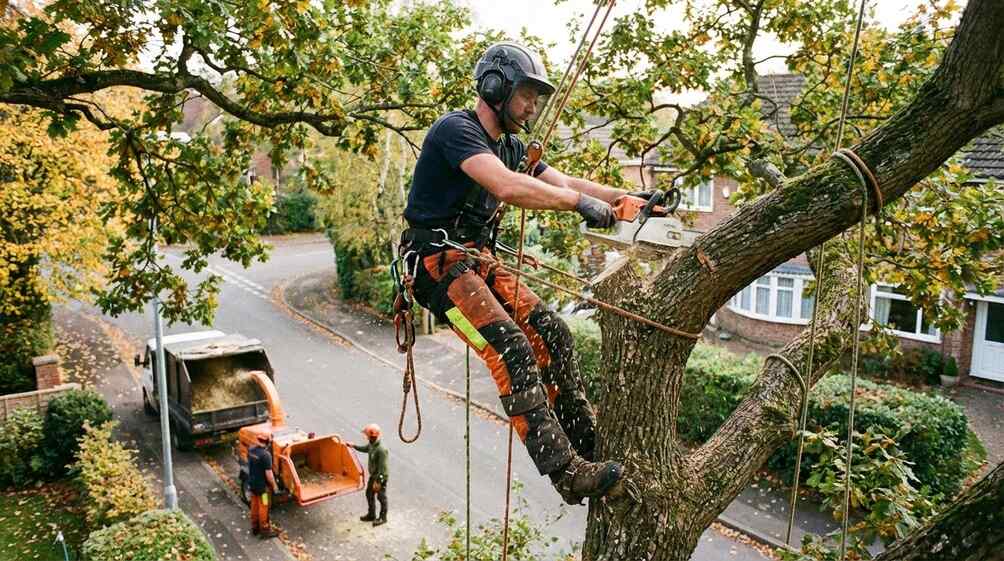
- Pecans grow 60 to 100 feet tall, making canopy work a high-risk job that requires professional equipment and safety protocols.
- Pecan wood tends to rip and tear during cuts, unlike most hardwoods. Without proper three-cut technique, you’ll rip bark off the trunk and open the door to decay.
- If you don’t have training in structural pruning, the decisions you make in the first five years can cause permanent damage.
- Spotting pecan scab, zinc deficiency, and aphid damage during a pruning visit takes training most homeowners haven’t had.
- Central Texas’s extreme summer heat and periodic drought stress complicate pruning timing and recovery.
Our arborists, Evan Peter (ISA Certified Arborist TX-4602A) and Lewis Heye (ISA Certified Arborist TX-3510A), have decades of experience with Central Texas pecans. Our tree pruning services in Austin are built on the same standards, and our ISA certified arborist in Austin credentials are on the record.
What Is the Difference Between a Tree Trimmer and a Certified Arborist?
An ISA Certified Arborist has passed a comprehensive exam on tree biology, diagnostics, pruning science, and safety. They maintain the credential through continuing education. A tree trimmer might own the equipment but miss proper cut placement at the branch collar, skip central leader training, or overlook diseases like pecan scab during a routine visit.
A pecan tree can live 300 years or more. That makes the expertise gap between a trimmer and a certified arborist worth taking seriously.
And in Austin, the local growing conditions raise the stakes.
Pecan Tree Pruning and Care Tips Specific to Austin, Texas
Central Texas presents specific conditions that affect when and how you should prune your pecans.
Austin sits in USDA Hardiness Zone 8b, which means shorter, milder winters than northern pecan-growing regions. Your dormant pruning window is narrower here. December through February is still the target, but warm spells can trigger early bud break, so watching your tree’s condition matters more than the calendar alone.
The soils across Central Texas are predominantly alkaline, which limits how much zinc your pecans can absorb. That’s a problem because your pecans rely on zinc for healthy shoot growth and nut development. If you’re in Austin, Cedar Park, Round Rock, Georgetown, Lakeway, Bee Cave, or Pflugerville, zinc deficiency is one of the most common pecan health issues you’ll run into. Our deep root fertilization in Austin delivers nutrients directly to the root zone where your pecans need them most.
Your mature pecans need 250 or more gallons of water per week during summer. If you prune during drought, you’re compounding stress and slowing wound healing. Wetter springs increase pecan scab pressure, so canopy thinning for airflow becomes even more important. Our tree healthcare services in Austin include diagnostics and treatment for the full range of pecan health issues.
The pecan is the Texas state tree, designated in 1919 by the Texas Pecan Board.
What Pecan Varieties Grow Best in the Austin Area?
Several pecan varieties do well in Central Texas, including Pawnee, Caddo, Kanza, Oconee, and Cheyenne. The variety you plant affects how much pruning you’ll need to do. Pawnee, for example, develops many narrow-angle branches that require more aggressive structural training in the early years.
Whether your pecan is brand new or decades old, an arborist who knows Austin should be your first call.
Get Expert Pecan Tree Pruning in Austin from Happy Tree Service
Happy Tree Service of Austin has been caring for Central Texas trees for more than 30 years. Our ISA-certified arborists understand what pecans in this area need. Our arborists, Evan Peter (TX-4602A) and Lewis Heye (TX-3510A), carry full liability and workers’ comp insurance for high-canopy work. Our 300+ five-star reviews speak for themselves.
That’s an investment worth protecting.
Call today for a free estimate: 512-212-0010.
From routine pecan tree trimming and canopy work in Austin to complex canopy work, we’re ready when your pecans need attention. Call us today at 512-212-0010 or reach out to us online for a free estimate.