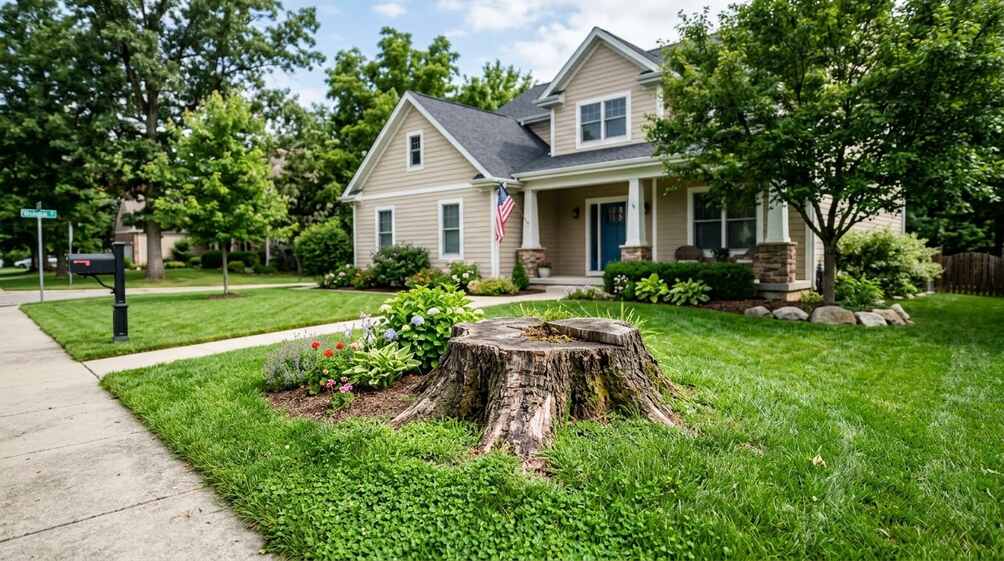
Stump Grinding vs. Stump Removal: Which Option Is Right for Your Austin Property?
Stump grinding is faster, less expensive, and less disruptive. It is the right choice for most Austin homeowners who simply want the stump gone and the yard restored. Stump removal extracts the entire root system and is the better option when you plan to replant a new tree in the exact same spot or need clear ground for construction.
In Austin’s clay soil and live oak terrain, both methods involve considerations most homeowners do not anticipate. If you are wondering whether it is better to grind a stump or remove it, this page explains the difference, the costs, and when each option makes sense for your property.
Grinding vs. Stump Removal: Which Option Is Right for Your Austin Property?
Stump grinding is faster, less expensive, and less disruptive. It is the right choice for most Austin homeowners who simply want the stump gone and the yard restored. Stump removal extracts the entire root system and is the better option when you plan to replant a new tree in the exact same spot or need clear ground for construction.
In Austin’s clay soil and live oak terrain, both methods involve considerations most homeowners do not anticipate. If you are wondering whether it is better to grind a stump or remove it, this page explains the difference, the costs, and when each option makes sense for your property.
What Is the Difference Between Stump Grinding and Stump Removal?
Stump grinding and stump removal are not two versions of the same process. They use different equipment, produce different results, and have different long-term effects on your property. Most homeowners use the terms interchangeably when deciding whether to remove or grind a tree stump, but the distinction determines which option is right for your situation.
Stump Grinding
A stump grinder reduces the stump to below the soil surface. The root system stays entirely underground and decays naturally over time. Wood chips fill the depression, and excess material is hauled away or left on-site based on your preference. Most single-stump jobs take one to two hours, and the compact equipment fits through fence gates and into tight yards.
Stump Removal
Full stump removal excavates the entire stump and root ball using heavy equipment such as a backhoe, skid steer, or hydraulic excavator. The process leaves a large hole that must be backfilled with clean soil and leveled. For mature live oaks in Central Texas, root spread can extend 4 to 12 feet beyond the visible stump.
The result is a complete clean slate with no underground roots and no possibility of root sprouts. For Austin homeowners who need full tree stump removal, this is the definitive solution.
After tree removal services in Austin are complete, the remaining stump presents homeowners with this choice. The right answer depends on what you plan to do with the space.
What Is Stump Grinding and How Does It Work?
A stump grinder uses a rotating cutting wheel with carbide-tipped teeth that chips the stump and visible surface roots into wood mulch. The wheel grinds the stump to a specified depth below grade, typically following ANSI A300 guidelines for professional stump work. The process produces a pile of wood chips and sawdust that fills the hole where the stump stood.
Does Stump Grinding Remove the Roots of a Tree?
No. Only the visible stump and surface roots are removed. The root system remains entirely underground and decays naturally, but the process is slow. Live oak roots in Central Texas clay soil can take 10 or more years to fully decompose. That matters if you are planning hardscaping, replanting in the exact same spot, or construction over the root zone.
Stump Grinding vs. Stump Removal: Side-by-Side Comparison
This table covers the factors that matter most when choosing between stump grinding and full stump removal. If you have 30 seconds, this is the section to read.
| Category | Stump Grinding | Full Stump Removal |
| Process | Rotating cutting wheel chips stump into mulch below soil level | Excavates the entire stump and root ball from the ground |
| Roots left behind? | Yes. Roots remain underground and decay naturally over years | No. Entire root system is extracted |
| Equipment required | Stump grinder (compact, fits most yards) | Backhoe, skid steer, or hydraulic excavator (requires more access) |
| Yard disruption | Minimal. Small depression filled with wood chips | Significant. Large hole and displaced soil requiring backfill |
| Time to complete | 1-2 hours for most single stumps | Half day to full day depending on size and root spread |
| Cost (Austin metro) | Less expensive. See detailed breakdown below. | Significantly more due to labor, equipment, and backfill |
| Replanting in same spot? | Not immediately in the exact spot. Offset planting recommended. | Yes. Clean slate for immediate replanting. |
| Construction or hardscaping? | Underground roots may interfere with foundations, pavers, and utilities | Removes all subsurface obstruction |
| Oak wilt considerations | Special handling required for infected oak stumps. See Austin-specific section below. | Removes stump, but trenching may still be needed to sever root grafts. |
| Best for most Austin homeowners? | Yes. The right choice for most residential situations. | When construction, immediate same-spot replanting, or root conflict is the driver. |
Is Stump Grinding Cheaper Than Stump Removal?
Yes, significantly. Grinding requires less equipment, less labor, and no backfill work. The cost gap widens on larger stumps because excavation, hauling, and soil replacement scale up quickly with root ball size.
How Much Does Stump Grinding Cost in Austin, TX?
Stump grinding in the Austin metro typically runs $150 to $500 per stump. The primary cost factors are diameter, species (live oak is denser and takes longer than cedar elm), accessibility, and grinding depth. Full stump removal runs $300 to $800 or more depending on size, root complexity, and backfill requirements.
When Stump Grinding Is the Right Choice for Austin Homeowners
For the majority of residential situations in Austin, stump grinding is the more practical, cost-effective, and less disruptive option. The following scenarios point toward grinding:
- You want the yard back without major excavation. The depression fills with wood chips and levels out over weeks.
- You plan to plant nearby but not in the exact same spot. Grinding is sufficient if the new tree can be positioned next to the old stump location.
- You are re-sodding or landscaping without immediate planting. Grinding below grade is sufficient for lawn restoration.
- The stump is in a tight-access location. Compact grinders fit through fence gates and narrow side yards that excavation equipment cannot reach.
- Budget is a primary consideration. Grinding costs significantly less than full removal.
- You want to eliminate the eyesore, tripping hazard, and pest risk. Stumps above grade attract termites, carpenter ants, and wood-boring beetles in Austin’s warm climate.
What to do with the wood chips: Stump grinding mulch can be used around other trees, shrubs, or garden beds. One exception: wood chips from oak wilt-confirmed stumps should not be spread near other oaks. Those chips should be removed or buried per ISA Texas Chapter guidelines.
Root sprouting after grinding: Some species (certain elms, mulberries, and invasives) produce root sprouts after grinding. A certified arborist can advise on whether preventive herbicide treatment is warranted.
A note on DIY stump grinding: Consumer-grade rental grinders lack the power for mature live oaks and sufficient depth in clay soil. The number of Austin properties with buried irrigation systems makes utility damage a common risk for rental operators.
Not sure which option fits your yard? Call 512-212-0010 for a free stump grinding assessment in Austin, TX from our ISA Certified Arborists.
How Deep Should a Stump Be Ground in Austin?
Grinding depth should match your plans for the space. These recommendations align with ANSI A300 standards:
- Lawn restoration or re-sodding: 4 to 6 inches below grade.
- Planting in the general area (not the exact spot): 6 to 8 inches.
- Hardscaping (pavers, gravel, decorative stone): 8 to 12 inches or more depending on installation thickness.
- Irrigation or drainage installation: Coordinate with the irrigation contractor for line depth.
Limestone pockets in West Austin neighborhoods can limit how deep a grinder can safely reach. An experienced crew will assess the rock situation before quoting.
Can I Sod or Plant Grass Over a Ground Stump?
Yes. After grinding to 4 to 6 inches below grade, the area can be backfilled with wood chips and topsoil, then sodded or seeded. Most homeowners see the surface level out within a few weeks.
Is Stump Grinding Enough If I Want to Landscape the Area Later?
For garden beds and sodded lawn, grinding is sufficient. For pavers, concrete, or a gravel patio, underground roots will decompose over years and leave voids that cause settling. If your plans include a rigid surface over the root zone, grind deeper or consider full removal.
When Full Stump Removal Makes More Sense
Full stump removal is the right choice in specific scenarios where underground roots are incompatible with your future plans. It is the deliberate choice when grinding’s limitations create real problems.
The following scenarios point toward full removal:
- You want to plant a new tree in the exact same location. Decomposing roots compete for space, water, and nutrients. Full removal creates the clean soil environment for the best start.
- Construction or hardscaping is planned over the root zone. Decomposing roots leave voids that cause settling and cracking. Full removal before construction is the professional standard.
- The stump is from a species with aggressive root sprouting. Certain elms and invasives send up sprouts even after the tree is gone. Full extraction eliminates that risk.
- Roots conflict with an existing structure or utility. Grinding the surface does not resolve root-to-structure conflict underground.
- The tree was infected with oak wilt. Special handling required. See the Austin-specific section below for the full protocol.
An ISA certified arborist in Austin, TX can assess whether full stump removal in Austin is necessary or whether grinding with targeted root management is a more practical alternative for your property.
Can I Plant a New Tree After Stump Grinding in Austin?
Yes, but offset the new tree 1 to 2 feet from the center of the old stump. Same-spot planting works better after full removal or after roots have fully decomposed, which can take a decade or more in Central Texas clay soil.
Should I Remove a Stump Completely If the Tree Had Oak Wilt?
Consult a Texas Oak Wilt Qualified arborist first. Grinding alone does not sever the root grafts that transmit oak wilt (Bretziella fagacearum) to neighboring live oaks. Trenching may also be necessary.
Will Underground Roots from a Ground Stump Damage My Foundation or Patio?
Decomposing roots leave voids that can cause surfaces above to settle and crack over time. If hardscaping or a foundation will be built over the root zone, full removal is the safer long-term choice.
Austin-Specific Considerations: Clay Soil, Live Oaks, Underground Utilities, and Oak Wilt
Austin homeowners face ground conditions and species factors that generic stump guides do not address. The four considerations below affect equipment choice, grinding depth, disposal protocol, and the decision between grinding and full removal.
Austin’s clay soil and limestone pockets
Central Texas soil ranges from expansive black clay to shallow limestone bedrock in Hill Country-adjacent West Austin neighborhoods. Clay compacts heavily around excavation equipment, making full removal more disruptive and more likely to require post-job grading than it would be in lighter soils. Limestone pockets can limit grinding depth when the cutting wheel hits rock. A crew experienced in neighborhoods like Tarrytown, Travis Heights, Barton Hills, and South Congress will assess conditions before quoting.
Live oak root systems and their unique behavior
Live oaks (Quercus fusiformis and Quercus virginiana) dominate the Austin metro. Their root systems are wide-spreading and shallow, with feeder roots extending 2 to 3 times the canopy radius. The visible stump is only a portion of the total root mass underground.
Properties planning hardscaping should factor in the full extent of lateral roots before choosing between grinding and removal. Tree healthcare services in Austin can help monitor the remaining trees on your property after stump work.
Underground utility marking: Texas 811
Before any stump work in Austin, underground utilities must be marked. Texas 811 is the state’s free utility marking service. Call 811 or submit online at least two business days before work begins.
Austin properties commonly have irrigation systems, buried electrical lines, and gas connections. If a crew begins grinding without confirming utility marking, that is a significant red flag.
Oak wilt considerations for oak stumps
Live oaks infected with oak wilt (Bretziella fagacearum) transmit the disease through root grafts with neighboring trees. Grinding the stump does not sever those connections. For stumps from confirmed oak wilt-infected trees, a Texas Oak Wilt Qualified arborist should advise on whether grinding alone is sufficient or whether trenching to sever root connections is also necessary.
Per ISA Texas Chapter guidelines, infected oak wood should be chipped, burned, or buried immediately. Wood chips from an infected stump should not be used as landscape mulch. The Texas A&M Forest Service documents that oak wilt spreads through root systems at significant rates, making proper protocol a neighborhood-level concern.
Happy Tree Service carries the Texas Oak Wilt Qualified credential (#TOWQ-436), and ISA Certified Arborist Evan Peter (TX-4602A) can assess the appropriate protocol for any oak stump in Austin. For full oak wilt treatment and removal services in Austin, Happy Tree Service evaluates both the stump and the surrounding root network.
Do I Need to Call 811 Before Stump Grinding in Austin?
Yes. Texas law requires utility marking before any digging or grinding. Texas 811 is free, and marking takes two business days. Call 811 or visit texas811.org.
Can Stump Grinding Spread Oak Wilt in Central Texas?
The grinding itself does not spread the fungus airborne. The risk is in the wood chips, which can harbor the pathogen, and in the root system, which maintains grafted connections to neighboring live oaks. Proper chip disposal and root network evaluation by a Texas Oak Wilt Qualified arborist are both part of the correct protocol.
Why Is Live Oak Stump Grinding Different from Other Tree Species in Austin?
Live oak wood is denser, the root system is wider and shallower, and live oaks form root grafts that create oak wilt transmission risk. These factors make live oak stumps a different job that benefits from a crew with specific experience in the species.
Get a Free Stump Grinding or Removal Estimate from Happy Tree Service: Serving All of Austin
Every stump is different, and the right recommendation depends on what is in the ground and what you plan to do with the space above it. A quick site visit is the fastest way to get a clear answer and a clear price.
- ISA Certified Arborist TX-4602A (Evan Peter), TRAQ Certified: Recommendation based on species, root behavior, soil, and future use.
- Texas Oak Wilt Qualified #TOWQ-436: Proper oak stump assessment and disposal protocol.
- Texas 811 compliance on every job.
- Full stump service: Grinding, removal, wood chip cleanup, backfill, and regrading.
- Service area: Austin, Round Rock, Cedar Park, Georgetown, Leander, Pflugerville, Lakeway, Westlake Hills, Bee Cave, Dripping Springs. Travis County and Williamson County.
- 300+ five-star reviews,9-star Google rating, 20+ years serving Central Texas.
- Office: 1108 Lavaca St, Suite 110-445, Austin, TX 78701.
- Free estimates available.
Ready to get rid of that stump? Call Happy Tree Service at 512-212-0010 for a free estimate, or submit your request online. Our certified team will assess your stump, explain your options, and give you a clear price before any work begins.