Storm Damage Tree Removal in Austin: When to Act, What to Expect, and How We Help
A storm-damaged tree leaning toward your home, resting on your roof, or trailing broken limbs is an active safety hazard. It needs professional response today, not next week. But not every storm-damaged tree needs immediate removal. Happy Tree Service of Austin prioritizes storm emergencies across the Austin metro and can typically respond the same day. Our ISA Certified Arborists assess the damage, advise on your options, and safely remove or restore your tree. Call 512-212-0010.
Storm Damage Warning Signs: When Your Austin Tree Cannot Wait
Not all storm damage is visible, and not all visible damage requires emergency tree removal.
SAFETY WARNING: Never approach a downed tree that is touching or near a power line. Call 911 and Austin Energy (512-322-9100) immediately. Stay at least 35 feet away. The ground around downed power lines can be energized.
Signs that require same-day emergency tree service in Austin:
- Tree resting on any structure. Roof, fence, vehicle, power line, or outbuilding. A single large limb can weigh more than one ton, and every hour it remains increases structural damage and water intrusion.
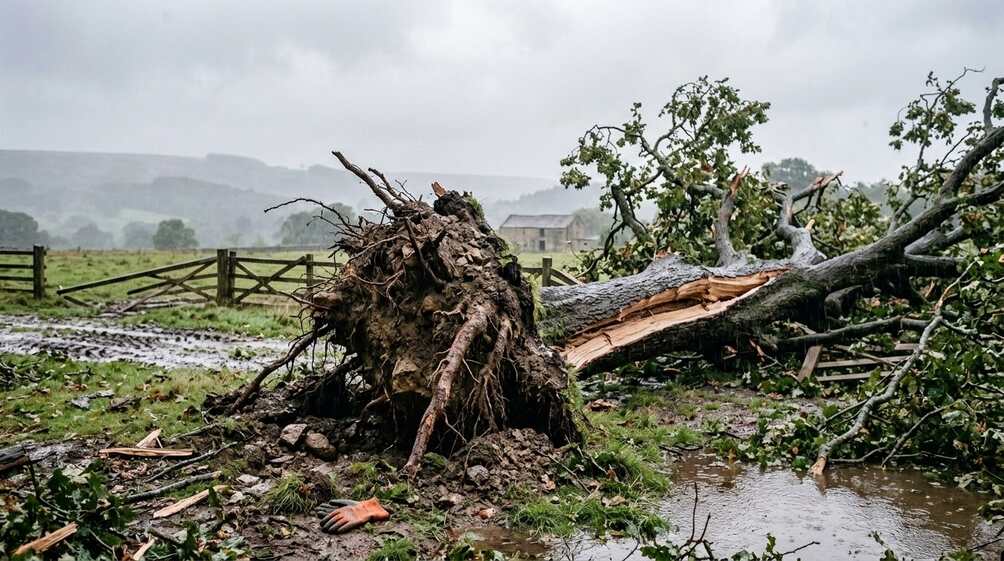
- Root ball lifting from the ground. An uprooted tree in saturated soil has lost anchorage and can fall in any direction without additional wind.
- Trunk cracked or split at the base. Vertical cracks, spiral cracks, or splits between co-dominant stems signal imminent structural failure.
- Severe lean toward a target. A leaning tree after a storm with a 15-degree or greater shift indicates root system damage or soil failure, not wind movement alone.
- Hanging broken limbs (widow makers) over occupied areas. A partially attached limb can fall without warning days or weeks after the storm.
Conditions that can typically wait for business hours:
- Branch loss limited to the outer canopy with no trunk or major limb damage
- Dead branches on the ground away from structures
- Minor lean predating the storm or canopy loss under 25%
Austin averages more than 40 severe thunderstorm warnings per year. Straight-line winds snap trunks at mid-height, making wind damaged tree removal one of the most common emergency calls. Microbursts like the May 2024 event concentrate extreme force over small areas.
Ice storms create slow weight-load failure. Winter Storm Mara (February 2023) generated more than 170,000 tons of debris across Austin, and ice storm tree removal stayed a priority for weeks. Lightning can cause internal cambium damage that leads to structural failure days later.
What should I do immediately after a tree falls on my house in Austin?
If a tree fell on your house or a tree fell on your roof, get everyone away from the area beneath it. Call 911 if anyone is trapped or power lines are involved. Do not remove debris from your roof. Shifting the load can cause collapse. Photograph all damage, then call a certified arborist.
How can I tell if a storm-damaged tree is going to fall?
Watch for any lean not present before the storm, fresh cracks in the bark, or soil heaving at the base. Some failures happen days later. Internal cracks weaken fibers while the trunk appears stable, and root systems loosened by saturated soil can fail under their own weight.
What is a widow maker tree limb and why is it dangerous?
A widow maker is a broken branch that did not complete its fall. It may be lodged in the canopy or held by a strip of bark, suspended for weeks before dropping with no wind. If one hangs over a walkway, driveway, or play area, professional hanging limb removal must happen immediately.
Why Austin Homeowners Call Happy Tree Service for Storm Damage Tree Removal
When you need an emergency arborist in Austin, Happy Tree Service delivers professional storm damage tree assessment using the same arboricultural standards required for permit applications and insurance documentation. This is not a general contractor or storm chaser crew.
- ISA Certified Arborist TX-4602A (Evan Peter). Verifiable at isa-arbor.com. Formal tree biology and structural risk training behind every assessment.
- TRAQ Certified (Tree Risk Assessment Qualified). Produces formal risk documentation for insurance claims and Heritage Tree permit applications.
- Texas Oak Wilt Qualified #TOWQ-436. Assesses and manages oak wilt transmission risk from storm wounds during the February through June high-risk window.
- Priority emergency response. Fallen trees, trees on structures, and hanging limbs are treated as true emergencies and scheduled ahead of routine work.
- Insurance documentation. Photographs, written assessments, and detailed invoices formatted for your insurance claim.
- 300+ five-star reviews, 4.9-star Google rating. Over 20 years serving Austin and surrounding communities.
- Fully insured. General Liability and Workers’ Compensation. You are not exposed if a crew member is injured on your property.
Are Happy Tree Service arborists certified for storm damage assessment in Austin?
Yes. Evan Peter holds ISA credential TX-4602A and TRAQ certification, the professional standard for documenting structural failure risk. You can verify any ISA certified arborist in Austin, TX at isa-arbor.com.
Does Happy Tree Service work with homeowners insurance for storm damage claims?
Yes. The team documents every call with photographs, species identification, diameter measurements, and a detailed scope of work. See the full insurance breakdown below.
Storm damage does not wait, and neither do we. Call Happy Tree Service at 512-212-0010 for prompt emergency response across the Austin metro.
Remove, Restore, or Wait? Your Options After Storm Damage
A certified arborist should assess any storm-damaged tree before a removal decision is made. Tree removal after a storm is not always necessary, and in Austin, removing a Protected Tree (19 inches DBH or larger) or Heritage Tree (24 inches DBH or larger) without documentation creates significant legal and financial exposure.
Option 1: Emergency Removal. Fallen tree removal is appropriate when any emergency warning signs are present: a tree on a structure, active root failure, cracked trunk, severe lean, or widow makers over occupied areas.
Even Protected or Heritage Trees can be removed on hazard grounds, but the condition must be documented and a TORA filed. A certified arborist handles both permit and insurance documentation in a single visit. Storm damaged tree removal in Austin covers the full process.
Option 2: Storm Restoration Pruning. Many trees that appear severely damaged can be saved. Crown restoration pruning removes broken or compromised limbs while preserving the tree’s structure and root system.
Native Texas trees, particularly live oaks (Quercus fusiformis) and cedar elms, often recover from significant crown damage when the trunk and roots are intact. This work must follow ANSI A300 pruning standards. Improper techniques like topping or lion-tailing accelerate decay. Crown restoration pruning in Austin explains what restoration pruning involves.
Essential timing for oaks: If the storm occurred between February and June, fresh cuts on oaks must be sealed immediately with pruning paint to prevent oak wilt (Bretziella fagacearum) transmission by nitidulid beetles. This must happen within minutes of each cut. The Texas A&M Forest Service Oak Wilt Program is the authoritative source for this protocol.
Option 3: Monitor and Assess. If a tree lost outer canopy but shows no trunk damage, no structure contact, and no widow makers, a professional assessment within the week is sufficient. Deep root fertilization supports recovery in Austin’s alkaline clay soils.
After removal, non-diseased wood can be chipped on-site, hauled away, or dropped at Hornsby Bend Biosolids Management Plant at no charge. Oak wood from a potential oak wilt infection must be burned, buried, or chipped immediately.
Remaining stumps should be ground below grade to eliminate trip hazards, pest attraction, and ongoing root transmission risk for live oaks in oak wilt areas. Happy Tree Service handles complete post-storm cleanup, including stump grinding after storm removal.
Reduce your risk before the next storm. Unpruned canopies act as wind sails, co-dominant V-shaped attachments split under load, and trees with trunk decay or girdling roots are already compromised. A pre-storm tree health evaluation identifies candidates for pruning, cabling, or proactive removal.
Can a storm-damaged tree in Austin be saved, or does it always need to be removed?
Many can be saved, especially native species with intact root systems and sound trunks. The arborist evaluates trunk integrity, root anchorage, crown loss percentage, and whether the remaining structure can sustain new growth.
Do I still need an Austin tree permit if my tree is an emergency hazard?
Yes. A tree removal permit is still required. Austin Land Development Code Section 25-8-621 requires documentation even for emergency hazard removals. File a TORA through the Austin Build + Connect (AB+C) Portal with the tree’s species, diameter at breast height (DBH), condition, and photographs.
How soon after a storm should I have my trees professionally assessed?
Immediately if emergency signs are present. Within the first week for non-emergency damage. Internal trunk cracks and loosened root systems can lead to collapse days after the storm with no additional wind.
Does Homeowners Insurance Cover Storm Damage Tree Removal in Austin?
Whether your homeowners insurance covers storm damage tree removal depends on where the tree fell, not on the storm itself.
| Scenario | Typically Covered? | Notes |
| Tree falls on and damages your house | Yes | Covers both removal and structural repair up to policy limits |
| Tree falls on detached garage, fence, or outbuilding | Often yes | Depends on whether the structure is listed as covered |
| Tree falls on your vehicle | Yes, under auto policy | Comprehensive auto coverage, not homeowners |
| Tree falls in your yard and damages nothing | Generally no | Most policies do not cover removal without structural damage |
| Neighbor’s tree falls on your property | Your insurance, not theirs | Neighbor liability applies only if negligence is proven |
| Tree damages a utility line or street | Contact Austin Energy / City of Austin | Depends on where the tree was rooted, public or private property |
Documentation Happy Tree Service provides:
- Photographs of the tree and all damage from multiple angles before removal
- Species, diameter, and condition documentation
- Detailed written invoice specifying scope, equipment, and cleanup
- TRAQ-certified arborist’s written assessment for disputed claims
Important: Policies vary significantly. Review your “trees, shrubs, and plants” coverage section before assuming coverage. Happy Tree Service provides the documentation. The coverage determination rests with your insurer.
Does homeowners insurance cover tree removal if no structure was damaged?
Generally, no. Most policies cover removal only when the tree damages a covered structure.
What documentation do I need for a storm damage tree removal insurance claim in Texas?
Photographs before removal, species and diameter records, a detailed invoice with scope and equipment, and a written arborist assessment for disputed claims.
Is my neighbor responsible if their tree falls on my property in Austin?
Usually not. Texas law treats storm damage from a healthy tree as an act of nature. You file with your own insurer. Neighbor liability applies only if you can prove they knew the tree was hazardous and failed to act.
Storm Chaser Crews vs. Certified Arborists: How to Vet Any Tree Service After an Austin Storm
After every major Central Texas storm, unlicensed out-of-state crews flood Austin neighborhoods with below-market offers. If an uninsured crew member is injured on your property, you may be financially liable. A low quote that creates uncovered liability is not a savings.
How to vet any tree service after a storm:
- Verify active General Liability and Workers’ Compensation insurance. Ask for a current certificate of insurance (COI) before work begins. Call the insurer to confirm the policy is active.
- Confirm ISA certification. Verify at isa-arbor.com by company or individual name. Takes 30 seconds.
- Look for a local Austin presence. A physical address, local phone number, and Google Business Profile indicate a local business, not a transient crew.
- Get everything in writing. A written estimate specifying scope, equipment, debris removal, and price protects you.
- Never pay in full upfront. A reasonable deposit is standard. Full payment before work begins is a red flag.
- Verify they understand Austin’s tree ordinance. Protected Trees (19 inches DBH or larger) may require a TORA permit even after storm damage. A crew unaware of this puts you at regulatory risk.
How do I know if a tree service in Austin is legitimate after a storm?
Check their insurance, verify arborist credentials at isa-arbor.com, confirm a local business address and history, and require a written estimate before work starts.
What is a storm chaser tree service and why should I avoid them?
Storm chasers are unlicensed, often out-of-state crews that follow severe weather and solicit work door-to-door. They typically lack insurance, credentials, and local ordinance knowledge. If something goes wrong, you absorb the liability.
What insurance should a tree removal company have in Texas?
General Liability and Workers’ Compensation at minimum. General Liability covers damage to your property. Workers’ Compensation covers crew injuries. Without it, an injured worker could file a claim against you.
Call Happy Tree Service for Storm Damage Tree Removal Across Austin and Central Texas
Happy Tree Service brings ISA-certified, TRAQ-qualified arborists with over 20 years of storm-damaged tree removal experience across Austin, full insurance coverage, and the documentation your adjuster needs.
If a tree is down, leaning, or hanging after a storm, do not wait. Call Happy Tree Service at 512-212-0010 for a free estimate and prompt emergency response. You can also submit a request at happytreeserviceofaustin.com/contact.
Serving: Austin, Round Rock, Cedar Park, Georgetown, Leander, Pflugerville, Lakeway, Westlake Hills, Bee Cave, Dripping Springs, and surrounding communities throughout Travis County and Williamson County.
Office: 1108 Lavaca St, Suite 110-445, Austin, TX 78701