When Is the Best Time to Prune Trees in Texas?
If you’re wondering when to prune your trees in Texas, the answer for most species is the dormant season, late November through February. For oaks, the safest window is July through January. You should avoid pruning oaks from February through June entirely, as that’s the highest-risk period for oak wilt transmission. You can remove dead or damaged branches any time of year. Both the Texas A&M Forest Service and the ISA recommend you hire an ISA-certified arborist for the job, especially on oaks.
When Is the Best Time to Prune Trees in Texas?
The dormant season works in your favor for several specific reasons. Your trees are conserving energy. The insects that spread disease aren’t active. And the wounds you create will close faster once spring growth kicks in.
Here’s why dormant-season pruning gives your trees the best outcome:
- Lower disease risk. The sap beetles responsible for spreading oak wilt aren’t active during cold months, so your pruning cuts aren’t exposed to infection.
- Less stress on your tree. With metabolic activity slowed, your tree isn’t burning energy to respond to wounds on top of everything else.
- Better visibility. Once your deciduous trees drop their leaves, your arborist can see the full branch structure and make more accurate cuts.
- Faster wound closure. Cuts made in late winter heal fastest because spring growth is right behind them.
Why Does Dormant-Season Pruning Work Best in Texas?
Your tree’s sap flow slows during dormancy, and metabolic activity nearly stops. Your tree stores energy in its roots and trunk instead of spending it on growth. When you prune just before spring, your tree redirects that stored energy toward closing wounds as soon as growth resumes. That means wounds made just before spring close faster than wounds made at any other time of year. The Texas A&M Forest Service recommends you prune in the late dormant season for exactly this reason.
This timing matters most for oaks, where the stakes are highest.
Best Time to Prune Oak Trees and Live Oaks in Texas
If you have oaks on your property, the safest window to prune them is July through January. That includes live oaks, red oaks, post oaks, and bur oaks. November through January is the ideal range within that window. February through June is the high-risk period for oak wilt transmission.
Your live oaks go through a natural leaf exchange in late winter, dropping old leaves as new growth emerges. That makes late fall and early winter the preferred pruning window for live oaks specifically.
- Safest months: July through January
- Ideal months: November through January
- Months to avoid: February through June (oak wilt season)
- Exception: Dead branches can be removed year-round
The reason these months matter comes down to one disease: oak wilt.
What Is Oak Wilt and Why Does Pruning Timing Prevent It?
Oak wilt is caused by a fungus called Ceratocystis fagacearum, and it can kill your oaks. When you prune an oak and leave a fresh wound exposed, sap-feeding beetles (nitidulids) can carry fungal spores directly into the cut. These beetles are most active from February through June.
If you have live oaks or red oaks, they’re the most susceptible species in Central Texas. Oak wilt also spreads underground through interconnected root systems, which means one infected tree can pass the disease to its neighbors.
Seal all oak pruning cuts with pruning paint or wound dressing immediately, within minutes, to block beetle access to the fresh wound. The Texas Oak Wilt Partnership and the City of Austin both recommend you seal cuts immediately. If your oaks already show signs of infection, our oak wilt treatment service can help.
Oaks get the most attention, but other common Texas species have their own pruning windows.
Pruning Calendars for Other Common Texas Tree Species
If you have pecans, crape myrtles, cedar elms, fruit trees, or spring-flowering ornamentals, each one needs to be pruned on a different schedule. Our seasonal tree care services in Austin are designed to match each species’ timing.
| Tree Type | Best Pruning Months | Months to Avoid | Notes |
| Live oak / Red oak / Post oak / Bur oak | July through January (ideal: November through January) | February through June | Seal all cuts immediately; oak wilt risk |
| Pecan | January through February | After sap flow begins | Structural pruning critical in first 5–7 years |
| Crape myrtle | Late February (before new growth) | No restricted period | Remove suckers, crossing branches, spent seed heads only; never top |
| Cedar elm | November through February (dormant season) | Avoid heavy spring pruning | Prone to elm leaf beetle; dormant pruning reduces stress |
| Fruit trees (peach, plum, citrus, fig) | Late winter, typically January through February (before buds appear) | After fruit set | Prune for open center structure and light penetration |
| Spring-flowering ornamentals (redbud, Texas mountain laurel) | Immediately after bloom, typically March through April | Before bloom (removes flower buds) | Prune within 2–3 weeks of bloom drop |
Two species in this list cause the most confusion: pecans and crape myrtles.
When Should You Prune Pecan Trees and Crape Myrtles in Texas?
Prune your pecans in January or February while they’re fully dormant. Structural pruning during your pecan’s first five to seven years sets it up for decades of solid nut production. Once sap begins to flow in spring, stop pruning for the season. If you prune too late, you’ll cause excessive sap bleeding that weakens your tree.
Prune your crape myrtles in late February, just before new growth pushes. Remove suckers at the base, crossing branches, and spent seed heads, and leave everything else alone.
Never top a crape myrtle. If you’ve seen crape myrtles hacked back to bare stumps around Austin, that’s crape murder, and it’s one of the most damaging pruning mistakes in Texas. It destroys the tree’s natural form, promotes weak regrowth, and has to be repeated every year.
Knowing when to prune matters. But in the Austin area, local ordinances add another layer of rules you need to follow.
Local Pruning Ordinances and Restrictions in the Austin Area
Depending on where you live in the Austin area, your city may enforce specific oak pruning windows and tree protection rules. These rules exist to prevent oak wilt and protect the trees in your neighborhood.
- City of Austin: Prune oaks July through January. You need a permit to prune more than 25% of a Protected Tree’s canopy (any tree with a trunk diameter of 19 inches or more, measured at 4.5 feet above ground) or to remove a Protected Tree entirely.
- Lakeway: You cannot prune oaks from February 1 through June 30. Fines apply. You need City Forester approval for any exceptions during the restricted period.
- Bee Cave: You cannot prune oaks from February 1 through June 30. Violations carry fines of up to $500 per day.
- Georgetown: You need a permit for Heritage Trees (oaks and other species with a trunk diameter of 26 inches or more, measured at 4.5 feet above ground). You can prune July 1 through January 31.
- Rollingwood / West Lake Hills: You cannot prune oaks from February 1 through June 30.
A certified arborist handles the timing, the permits, and the paperwork so you don’t have to.
These aren’t just guidelines. They carry real financial consequences.
Can You Get Fined for Pruning Oaks at the Wrong Time in Austin?
Yes. In Bee Cave, violations of the oak pruning window carry fines of up to $500 per day. In Lakeway, you need City Forester consent for any exception during the February through June restricted period. In Austin, you face permit requirements and penalties under the Protected Tree rules if you don’t comply.
Staying on the right side of these rules is one more reason to hire a certified arborist. But it’s far from the only one.
Why a Certified Arborist Should Handle Your Tree Pruning
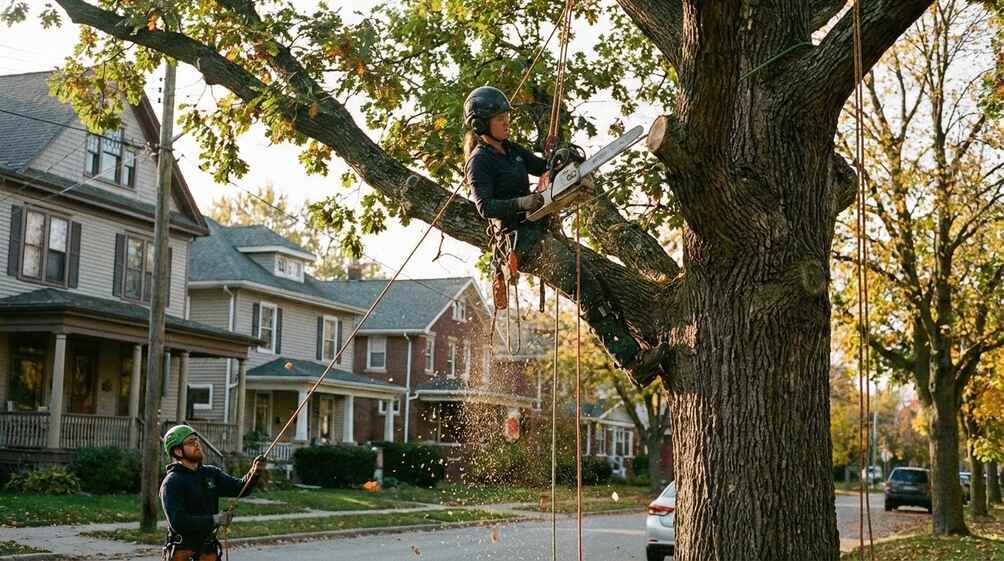
The person making the cuts on your trees determines whether they heal properly or suffer long-term damage. When you hire an ISA-certified arborist in Austin, you’re getting someone trained in tree biology and proper cut placement. They follow ANSI A300 standards (the national standard for tree care practices), understand species-specific care, and can identify disease and structural problems during the work. Our tree pruning services in Austin are built on these standards.
When pruning is done without that training, the risks add up fast:
- Over-pruning or topping, which removes too much canopy and starves the tree
- Lion-tailing, which strips interior branches, leaving outer limbs prone to breakage
- Flush cuts that destroy the branch collar and prevent proper wound closure
- Spreading disease by moving unsterilized tools between trees
- Personal injury from working at height without proper equipment or fall protection
What separates an arborist from a tree trimmer is training.
What Is the Difference Between an Arborist and a Tree Trimmer?
To earn ISA certification, an arborist has to pass an exam covering tree biology, soil science, disease identification, and risk assessment. They also maintain continuing education credits, so their knowledge stays current. A tree trimmer may own chainsaws and a bucket truck. But without formal training, they can’t assess your tree’s health. They can’t identify disease. And they can’t make cuts that promote long-term structure.
At Happy Tree Service, our ISA-certified arborist Evan Peter (TX-4602A) leadS every pruning project. That level of expertise shows up in every cut, every diagnosis, and every project plan.
Without that expertise, a bad pruning job can cause damage that lasts for years.
What Happens When You Prune at the Wrong Time?
The wrong timing or technique doesn’t just set your tree back. It can cause permanent damage.
If you have oaks, the most serious consequence is oak wilt. A single cut on your oak during the February through June risk window can attract sap beetles carrying fungal spores. Once the fungus enters your tree, it can spread through root systems to neighboring oaks.
For all species, pruning during peak heat or immediately after the spring growth flush puts your tree under significant stress. Wounds close slowly, and internal decay sets in where wood is exposed. Your tree loses the canopy it needs for photosynthesis, and your weakened tree attracts secondary pests like borers.
Working with an ISA-certified arborist is how you avoid these risks.
Can Pruning Kill a Tree if Done at the Wrong Time?
Yes, especially oaks. A single improperly timed cut on your live oak during spring can introduce oak wilt through beetle-carried spores. The fungus spreads underground through interconnected root systems, and your neighbors’ oaks are at risk too.
Even if your trees aren’t oaks, pruning during peak summer heat causes significant stress. Wounds close slowly, and your tree becomes more vulnerable to pests. A certified arborist protects you from both the biological risks and the legal ones.
The safest move is to bring in a professional from the start.
Schedule Expert Tree Pruning in Austin with Happy Tree Service
We’ve been pruning, treating, and caring for trees across Austin, Lakeway, Bee Cave, Georgetown, Cedar Park, Round Rock, and the surrounding area for over 30 years. Happy Tree Service of Austin is locally owned and built on long-term relationships with homeowners like you.
Our ISA-certified arborist, Evan Peter (TX-4602A) leadS every pruning project. We carry full liability and workers’ comp insurance. We’ve earned over 300 five-star reviews from Austin-area homeowners.
Whether you need tree pruning services in Austin, seasonal tree care, or a full tree trimming service, we time every project to your trees’ specific needs and follow every local ordinance.
Call us today at 512-212-0010 or reach out to us online for a free estimate. Your trees are in good hands with an ISA-certified team.