Oak Wilt: Its Causes and How We Can Treat It
On the way out of the house this morning, you noticed that your Live Oaks could use a bit of trimming. Now, you’re on your way home from work. You’re thinking of calling Happy Tree to do that trimming, since they did such a great job last time around. Suddenly, there it is: A BIG sign posted by your HOA: “Avoid Oak Wilt! Do not trim your Oaks from mid-February through mid-June!” What is going on? Should you forget about having your Oaks trimmed, since it’s the middle of April?
Oak Wilt Causes
Oak wilt is caused by the fungal pathogen Ceratocystis fagacearum. This fungus invades oaks, mainly Red Oaks and Live Oaks, via root grafting from previously infected trees, and by having fungal spores deposited in open wounds and cuts by a vector agent, the Nitidulid Beetle. In the case of spore deposition by the beetle, once the spores germinate in the sap and conductive tissue of the tree, the fungus circulates throughout the tree. When the growing fungal pathogen is established in the conductive tissue, the leaves of the tree can no longer transport sugars throughout the tree, and water transport is also inhibited. This results in very rapid death, in Red Oaks, and a downward mortality spiral, in Live Oaks. White Oaks can also get oak wilt, although there is some evidence that they have more resistance to it than the aforementioned Red and Live Oaks.
Signs of Oak Wilt Infection are Fairly Clear in Live Oaks:
Veinal necrosis, a pattern seen in leaves where the veins are orange, spreading out in a diffuse orange to the surrounding green leaf tissue, is a fairly reliable confirmation of infection. Live Oaks can survive an infection for a period of years, with more and more leaves showing the veinal necrosis symptom until the time that most leaves have fallen and are no longer replaced by the tree. Death follows. Foliar symptoms of oak wilt on Red Oaks are less distinct. In early spring, young leaves simply wilt, turning pale green and brown, usually remaining attached for a period of time. Mature leaves develop dark green, water-soaked symptoms, or turn pale green or bronze, starting at the leaf margins and progressing inward. This can begin on one branch and quickly engulf the entire tree. Red Oaks generally die within 4-6 weeks.
Red Oaks Develop Fungal Mats During the Infective Process
These mats are composed of groups of spore-bearing bodies that grow under the bark, raising it, slightly, in areas, normally on the trunk. The mats put off a distinctive odor, similar to Juicy Fruit gum. The nitidulid beetles can smell this odor from a good distance away, depending on prevailing wind conditions. They land on the tree, eat the fungal mats, and pick up spores in the process.
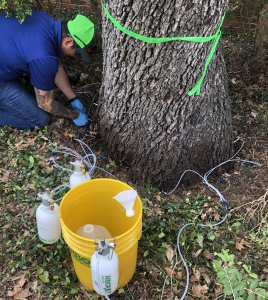
Though each species of oak has different tolerance levels to the disease, all oaks can be infected. Pruning, using climbing spikes, nailing objects, and storm damages during the warmer months can introduce the fungus into new trees. Once one tree has been infected, it is possible for the infection to spread to other oaks through interconnected roots or pests. The resulting deaths of infected oaks can lead to costly removal, unnecessary stress, and can even affect the surrounding ecosystem. For more information, contact our professional arborists today. Our team includes trusted tree healthcare experts Austin homeowners depend on for diagnosis, prevention, and long-term care.
Austin’s Oak Wilt Expert Services
The successful management of Oak Wilt is dependent upon accurate diagnosis and an understanding of how the fungus and different oak species interact. Our specialists are able to identify the species of oak, as well as the best action to take going forward. We are happy to help you with oaks on any property. Along with oak wilt care, we also provide seasonal tree care services Austin residents rely on to keep landscapes thriving year-round. Contact us today to learn more about how we can help you prevent and treat Oak Wilt!




 Let me tell you, I got so many different bids and different tree companies to come out and look at my trees. Evan said just a few words and I knew Happy Tree Service was the one. He REALLY knows trees and cares about your trees. We had to make a tough decision about cutting down a tree and he even called his father to get exact instructions so we would be successful at having a branch root and start over with the same tree.