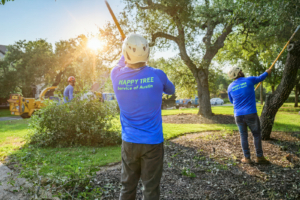
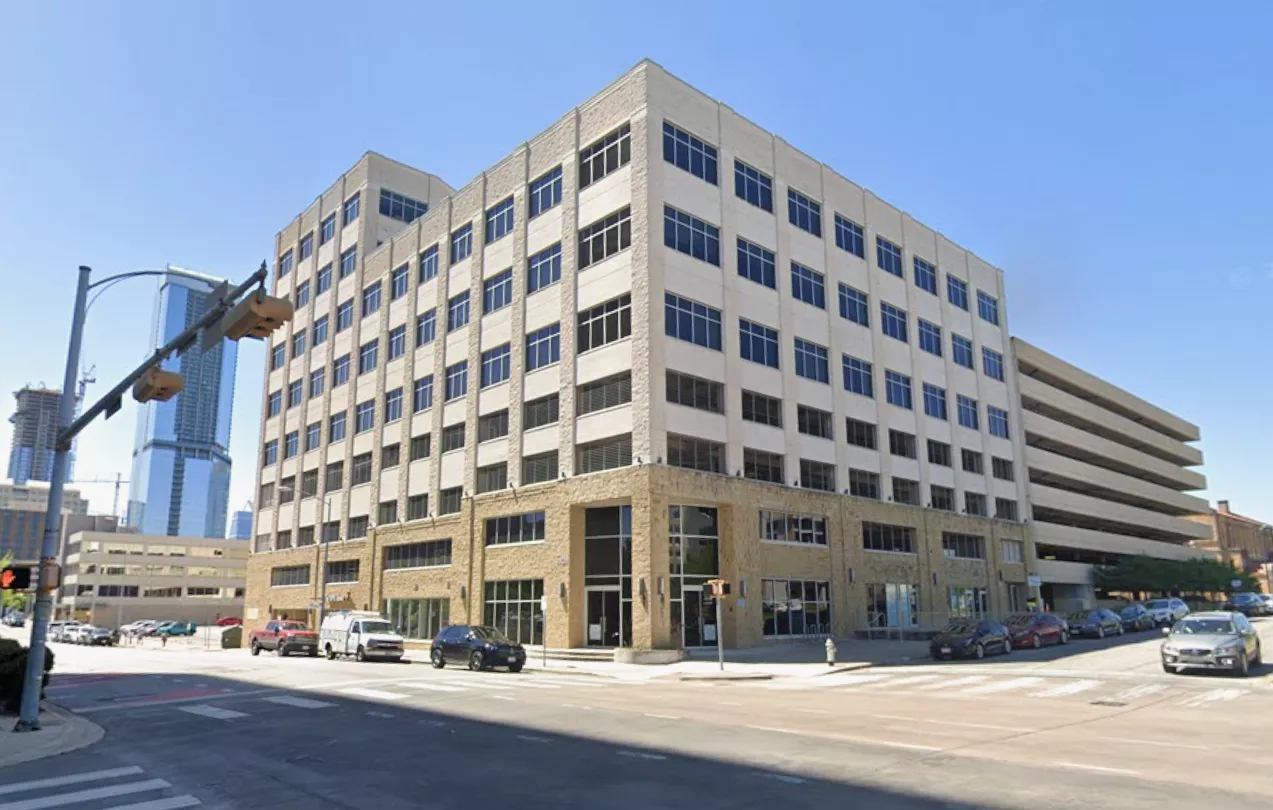
Why Choose Happy Tree Service of Austin as Your Lakeway Commercial Arborist
Here is what Happy Tree Service brings to every Lakeway commercial property:
- ISA Certified Arborist on staff: Evan Peter (TX-4602A) holds credentials from the International Society of Arboriculture. Learn more about our ISA Certified Arborists
- TRAQ Certified (Tree Risk Assessment Qualification): Formal risk assessments that record tree hazards with condition ratings, photos, and prioritized recommendations.
- Texas Oak Wilt Certified (#TOWQ-436): Required for accurate diagnosis and treatment across Lakeway’s mature live oak canopy, and for compliance with the city’s Diseased Tree Ordinance.
- Pesticide Applicator License (#0967351): Issued by the Texas Department of Agriculture for legal pesticide and fungicide applications on commercial properties.
- Fully insured: General liability and workers’ compensation coverage transfers risk from your property to ours during every job.
- Hillside and lakeside expertise: Experienced on Lakeway’s bluff lots, steep grades, and shoreline properties where standard methods fall short.
- Board-ready documentation: Line-item estimates, inspection reports, prioritized work scopes, and post-work completion reports formatted for board review.
- 300+ five-star Google reviews, 20+ years in Central Texas: A proven track record across commercial properties throughout the Lakeway and greater Austin corridor.
What role do certifications and insurance play when hiring a commercial tree company?
ISA certification confirms demonstrated competence in tree biology, risk assessment, and pruning standards. Insurance carriers and property management firms recognize it as the baseline for commercial tree work. Verified credentials and current insurance create a record of professional oversight that protects your organization if a claim arises.
Commercial Tree Trimming, Pruning & Removal for Lakeway Businesses and HOAs
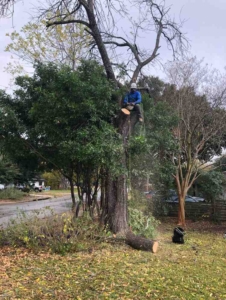
Routine trimming and planned removals keep your Lakeway commercial property safe, accessible, and maintained for tenants, residents, and visitors. Every cut on a commercial site serves a specific purpose: clearance, risk reduction, structural improvement, or view preservation.
Clearance trimming addresses overhanging limbs above walkways, parking areas, driveways, and signage. Deadwood and hazardous limb removal targets branches that could fall on vehicles, pedestrians, or building entries during Central Texas storms. Canopy shaping maintains curb appeal while preserving the lake and Hill Country views that define Lakeway’s appeal.
Lakeway’s hillside, bluff, and lakeside terrain requires specialized techniques beyond standard methods. Work on steep grades and near shoreline structures uses rigging, sectional dismantling, and lowering methods that protect retaining walls, pool decks, irrigation systems, and hardscape. Stump grinding and site restoration follow every removal.
All pruning and removal follows ANSI A300 industry standards, coordinated with your facilities team and scheduled around business hours, resident activity, and HOA notification requirements.
How is commercial tree trimming different from residential service?
Commercial trimming operates at a different scale with higher liability exposure, stricter scheduling constraints, and compliance requirements residential work does not carry. Work must be coordinated around business operations, tenant access, resident activity, and architectural committee rules.
Your team receives written work scopes before the job starts, pre-work notifications for residents or tenants when applicable, and completion reports with updated tree condition notes after every visit.
Tree Risk Assessments, Liability Management & HOA Board Reporting
A single tree failure on your commercial property can result in blocked access, damaged vehicles, injured tenants, and litigation questioning whether the hazard was identified and addressed before it caused harm.
Happy Tree Service’s TRAQ-qualified arborist performs on-site assessments covering every tree on your property. On Lakeway’s hillside and shoreline lots, assessments pay special attention to trees where slope erosion and soil movement destabilize root systems over time. The outcome is a written risk report your board can use for insurance claims, legal proceedings, and HOA governance.
For larger properties, full tree inventories with species, sizes, condition data, and multi-year budget projections are available to help your board plan capital expenses across fiscal years. Our arborists are also available to attend HOA board meetings to present findings directly.
What does a commercial tree risk assessment include?
A TRAQ-qualified assessment begins with a ground-level visual inspection of every tree on your property. The arborist evaluates canopy structure, root stability, trunk condition, branch attachments, and proximity to targets such as walkways, parking areas, and structures.
Each tree receives a risk classification (low, moderate, high, or extreme) based on the International Society of Arboriculture’s framework. The written report maps each tree to its location with photographs, prioritized corrective actions, and cost estimates formatted for board presentation and insurance filing.
Oak Wilt, the Lakeway Oak-Pruning Ordinance & HOA Compliance
Lakeway enforces one of the strictest oak-pruning ordinances in Central Texas under Article 14.06 of the city’s Code of Ordinances, known as the Diseased Tree Ordinance. Violations carry fines of $500 to $1,000 per day, and the ordinance applies to all property types including commercial and HOA common areas.
Key provisions of the Lakeway oak-pruning ordinance:
- Oak pruning is prohibited from February 1 through June 30 (high-risk season for oak wilt infection)
- Oak pruning is permitted from July 1 through January 31
- All oak wounds must be sealed with black pruning seal within 10 minutes of creation, regardless of the month. Failure to seal within 10 minutes is an unlawful violation
- Emergency exceptions during the restricted season require advance approval from the City Forester (512-314-7538)
- Safest months for oak pruning: November, December, and early January
- Second-best window: July and August during peak summer heat
Overplanting of live oaks during Lakeway’s rapid development phase in the 1980s contributed to the oak wilt epidemic the city faces today. The fungus Ceratocystis fagacearum spreads through nitidulid beetles attracted to fresh pruning wounds and through underground root grafts that connect neighboring live oaks. On a commercial property or HOA common area, a single infection can move through interconnected root systems to dozens of trees across property lines before symptoms appear above ground.
Happy Tree Service holds Texas Oak Wilt Certification (#TOWQ-436) and schedules all commercial oak work within the permitted window. Our crews sterilize tools between every tree and seal all wounds immediately. When infection is confirmed, we recommend fungicide injections for high-value specimen trees that may respond to treatment, and trenching to sever root grafts and halt spread.
Lakeway has a cooperative cost-sharing program with the Texas A&M Forest Service for trenching and removal of infected red oaks, and we can advise your board on eligibility. Learn more about our oak wilt treatment and removal protocols.
Permits and HOA approval: Some commercial tree removals in Lakeway require a city permit under § 24.02.405, processed through Building and Development Services. Most Lakeway HOAs also require architectural review committee approval before any tree is removed from common areas or individual lots. Happy Tree’s arborist advises on both city and HOA requirements and coordinates the required documentation.
When can commercial oaks be pruned in Lakeway, and do removals need approval?
Oak pruning is permitted from July 1 through January 31 and prohibited from February 1 through June 30 under Lakeway’s Diseased Tree Ordinance (Article 14.06). All oak wounds must be sealed with black pruning seal within 10 minutes of creation, regardless of the season. Emergency pruning during the restricted months requires advance approval from the City Forester.
Commercial tree removals may require a City of Lakeway permit under § 24.02.405, and most Lakeway HOAs require architectural review committee approval before any tree is removed. Happy Tree handles both the city permit process and the HOA documentation on your behalf.
Annual Commercial Tree Management Programs & Scheduling
Reactive tree work costs more than planned maintenance, and emergency removals, after-hours callouts, and unbudgeted board approvals all carry premium pricing. The most cost-effective approach is a documented annual management program with defined service visits, prioritized work scopes, and predictable costs.
- Property consultation and tree inventory: An ISA Certified Arborist walks the property, inventories all trees, and documents species, size, condition, and risk rating.
- Risk assessment and prioritized work scope: Trees are ranked by risk level, with hazards near high-traffic zones and building perimeters addressed first.
- Phased plan aligned to your budget cycle: Line-item estimates map each tree or group to a work scope and cost, phased across quarters or fiscal years for larger properties.
- Scheduled execution with minimal disruption: Work is timed around business hours and resident activity, coordinated with your facilities team.
- Post-work reporting: After each visit, your property manager receives a completion report with updated tree condition notes and recommendations for the next cycle.
- Ongoing re-inspection: The program continues on a defined schedule with inspections that catch emerging issues before they become emergencies.
All oak pruning within the program is scheduled during the permitted July through January window to keep your property compliant with Lakeway’s ordinance. Deep root fertilization services are available as a program component for mature trees on Lakeway’s compacted Hill Country soil.
Program clients receive prompt storm-response dispatch for fallen trees, split trunks, and hazardous limb situations. All pricing is contract-based and transparent, with net-30 billing available for commercial accounts.
How much does a commercial tree maintenance program in Lakeway cost?
Cost depends on property size, total tree count, species mix, terrain access, risk profile, and the frequency of scheduled visits. An HOA managing 200+ live oaks across common areas, trails, and streetscapes requires a different scope than a small office property with 15 trees.
Happy Tree Service provides free on-site property assessments with detailed, line-item proposals. Call 512-212-0010 or request a free commercial estimate online to schedule a walk-through at your convenience.
Schedule Commercial Tree Service in Lakeway with Happy Tree Service of Austin
Happy Tree Service of Austin provides free property consultations for all commercial tree care in Lakeway. From scheduled maintenance and oak-ordinance compliance to prompt storm response, your property receives certified, board-ready tree care backed by 20+ years of Central Texas experience. We serve Lakeway, Lake Travis, Bee Cave, Westlake, and the greater Austin metro. Call 512-212-0010 or request a free commercial proposal online.
How do I get a commercial tree service quote in Lakeway?
Call 512-212-0010 or submit a request through our online contact form. An ISA Certified Arborist will schedule a property walk-through at your convenience to assess your trees, document conditions, and deliver a detailed proposal with line-item pricing. All consultations are free for Lakeway commercial and HOA-managed properties.