Why Trust Happy Tree Service as Your Commercial Tree Care Provider in Bee Cave
On a commercial property, a single unqualified pruning cut or a missed hazard can expose you to lawsuits, insurance disputes, and regulatory fines. Your credentials checklist should be short and nonnegotiable.
What Credentials Should a Commercial Tree Service in Bee Cave Have?
When you hire a commercial tree service in Bee Cave, verify these before signing a contract:
- ISA Certified Arborist: Confirms your provider has passed the International Society of Arboriculture exam and maintains continuing education.
- TRAQ certification: Means your arborist can conduct formal risk evaluations that hold up in insurance reviews and board presentations.
- Texas Oak Wilt Qualified: Essential in Bee Cave, where oak wilt is confirmed across Travis County. This qualification means your provider follows the protocols that prevent disease spread during pruning and removal.
- Pesticide Applicator License: Required by the Texas Department of Agriculture for any provider applying treatments to your trees. An unlicensed applicator puts your property at legal and environmental risk.
- General liability and workers’ compensation insurance: Protects you if something goes wrong on your property. Ask for certificates. If a provider can’t produce them, move on.
- Familiarity with Bee Cave ordinances: Your provider should know the caliper thresholds, the permitting process, and the pruning-season restrictions without having to look them up.
Happy Tree Service holds every credential on this list. Our lead ISA Certified Arborist is Evan Peter (TX-4602A). He’s TRAQ certified, Texas Oak Wilt Qualified (#TOWQ-436), and a licensed pesticide applicator (#0967351). We carry full liability and workers’ compensation insurance and work within Bee Cave’s ordinances daily.
Tree Risk Assessments & Ongoing Maintenance Plans for Bee Cave Properties
A TRAQ-certified arborist walks your property, evaluates every tree, and delivers a written report you can hand to your board or your insurer. That report identifies structural defects, disease, and failure potential so you can act before a problem turns into an emergency.
| Assessment Area |
What It Identifies |
Why It Matters for Your Property |
| Canopy structure |
Dead limbs, asymmetric loading, excessive weight |
Branches falling over your walkways and parking areas put you at direct liability risk |
| Root anchorage |
Root damage from construction, soil compaction, grade changes |
Weakened roots are more likely to fail in storms, especially in Bee Cave’s shallow limestone soil |
| Branch unions |
Codominant stems, included bark, weak attachments |
Structural failure at branch unions is one of the most common causes of property damage you’ll face |
| Trunk condition |
Cavities, decay columns, fungal fruiting bodies, cracks |
Trunk defects go unnoticed until the whole tree comes down |
| Soil and site conditions |
Compaction, poor drainage, root-zone encroachment |
Construction activity around Bee Cave commercial sites frequently damages root zones you can’t see |
| Disease indicators |
Oak wilt symptoms, bacterial leaf scorch, pest infestations |
Early detection saves you from spread to neighboring trees and significantly higher treatment costs |
We deliver a written report with findings, risk ratings, recommended actions, photos, and a suggested timeline. Your ongoing maintenance plan builds on that report and turns it into a 12-month care calendar covering scheduled pruning, deep-root fertilization, pest monitoring, and storm-preparedness inspections.
How Often Should Commercial Trees in Bee Cave Be Inspected?
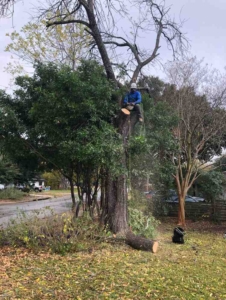
Your high-traffic commercial property should receive a full TRAQ assessment at least once per year, with additional inspections after any major storm event. Annual evaluation is the ISA-recommended baseline for properties where trees are near structures, walkways, parking areas, or public gathering spaces.
Timing matters here. Oaks in Bee Cave should only be pruned between July and January to reduce oak wilt transmission risk. Bee Cave’s ordinance under Section 26.03.006 requires that all pruning cuts on oaks be sealed immediately and that tools be sterilized between trees. Your annual care plan should build these windows into the schedule from the start.
Commercial Tree Removal & Emergency Storm Response in Bee Cave
When a tree on your commercial property needs to come down, the process requires certified assessment, safety planning for occupied sites, permit compliance, and documentation that satisfies your insurer and your board.
Here is how we handle commercial removals and emergency response:
- Arborist assessment: We evaluate the tree’s condition, structural integrity, proximity to buildings and utilities, and species-specific risk factors like oak wilt.
- Safety planning: We establish safety zones, traffic management, and access routes, coordinating around your business hours, tenant access, and pedestrian flow.
- Removal or stabilization: We bring the tree down in controlled sections using rigging, crane work, or directional felling based on your site. For emergencies, we stabilize the hazard, secure the area, and prevent secondary damage.
- Debris clearing and stump grinding: We remove all debris and grind stumps below grade for repaving, replanting, or surface restoration.
- Documentation and site cleanup: We provide a written record of the work, including pre- and post-removal photos and any permit-related documentation. We leave your site clean and inspection-ready.
Bee Cave’s terrain adds real complexity to this work, from steep hillside lots to mature oaks growing tight against structures and power lines.
Does Bee Cave Require a Permit for Commercial Tree Removal?
Yes. Bee Cave regulates tree removal through its tree preservation ordinance, and the thresholds apply to your commercial property. A protected tree has a caliper of four inches or more, a significant tree is eight inches or more, a specimen tree is 12 inches or more, and a heritage tree is 24 inches or more. If you need to remove any tree at or above the protected threshold, you’ll need a permit and a landscape plan showing replacement trees.
We handle permit applications, compliance documentation, and replacement-planting plans for you. You don’t need to interpret the ordinance or manage the paperwork.
HOA & Property Management Tree Care Programs in Bee Cave
Happy Tree Service builds structured care programs for HOA boards and property managers in Bee Cave. Here is what your program includes:
- Annual care calendars built around your property’s seasonal needs
- Board-ready reports with findings, photos, risk ratings, and recommended actions
- Common-area tree management covering parks, trails, pool areas, entryways, and streetscapes
- Coordination with your landscape contractor so tree work and ground maintenance stay aligned
- Budget forecasting with projected costs broken out by service type and priority
- Multi-property planning for management companies overseeing more than one community
Communities like Falconhead, Spanish Oaks, The Uplands, and Homestead all have mature canopies, active governance, and landscape standards that call for consistent, professional management. A structured program keeps your trees healthy, your residents satisfied, and your board informed with documentation they can actually use.
Bee Cave’s Unique Tree Care Challenges for Commercial Properties
Bee Cave is not a generic Central Texas suburb. The geology, climate, disease pressure, and regulatory environment here all demand local expertise.
| Bee Cave Condition |
Risk to Your Trees |
What This Means for Your Property |
| Shallow limestone soil |
Limits root depth and anchorage, raises storm-failure risk |
Your property needs more frequent stability assessments and proactive structural pruning |
| Steep terrain and rocky substrate |
Complicates equipment access and increases root-zone erosion |
Your tree care provider needs specialized rigging and site-specific safety planning |
| Oak wilt (confirmed in Travis County) |
Kills red oaks rapidly and spreads through root grafts to neighboring live oaks |
All oak pruning on your property must follow the July-through-January window with immediate wound sealing and tool sterilization |
| Drought stress |
Weakens trees over time, making them vulnerable to pests, disease, and structural failure |
Deep-root fertilization and soil management should be part of your annual care plan |
| Wind exposure on hilltop properties |
Increases mechanical stress on canopies, especially broad-crowned mature oaks |
Properties along FM 620, Hamilton Pool Road, and FM 2244 need wind-load assessments as part of routine TRAQ evaluations |
| Protected and heritage tree regulations |
Removal or damage without a permit carries fines and replacement requirements |
Every removal and major pruning decision on your property must be checked against Bee Cave’s caliper-based protection thresholds |
Get a Free Commercial Tree Care Estimate in Bee Cave
Managing trees on a commercial property takes more than occasional trimming. It takes a team that understands Bee Cave’s landscape, holds the right certifications, and builds a plan around your property’s specific needs. Happy Tree Service of Austin has served commercial clients across Bee Cave and the Hill Country for over 30 years, and our 4.9-star Google rating with more than 300 reviews reflects the long-term relationships we build with the property managers who count on us.
Call 512-212-0010 or request a free commercial estimate through our website.
Frequently Asked Questions
What does a commercial tree service include?
Commercial tree care covers everything your business, HOA, or managed property needs to keep trees safe and compliant. That starts with trimming, pruning, and structural corrections, and extends to removals, stump grinding, risk assessments, oak wilt treatment, emergency storm response, and ongoing maintenance programs. We build the plan around your property.
How much does commercial tree trimming cost in Bee Cave, TX?
Pricing depends on your property’s size, tree count, access conditions, risk level, and whether permits or compliance documentation are involved. Bee Cave’s mature oaks, rocky terrain, and ordinance requirements often add complexity. We provide free estimates for every commercial property so you get an accurate quote based on your specific situation.
Do you need a permit to remove a tree in Bee Cave, Texas?
Yes. Bee Cave requires a permit for removing any tree with a caliper of four inches or more, with additional classifications at eight, 12, and 24 inches. You’ll need to submit a landscape plan showing replacement trees. We handle the full permitting process for commercial clients.
What is the best time to trim oak trees in Central Texas?
Prune your oaks between July and January. This window reduces the risk of oak wilt transmission because the fungal mats and insect vectors responsible for spreading the disease are most active in spring. Bee Cave’s ordinance requires immediate wound sealing and tool sterilization on all oak pruning work. Build your commercial pruning schedule around this window from the start.
How do I find a certified arborist near Bee Cave?
Verify that your provider holds ISA Certified Arborist status, TRAQ certification, a Texas Pesticide Applicator License, Texas Oak Wilt Qualification, and both general liability and workers’ compensation insurance. Confirm they know Bee Cave’s tree preservation ordinances. Happy Tree Service meets every one of these criteria.
What is a tree risk assessment and why does my commercial property need one?
A TRAQ-certified arborist inspects your trees for canopy defects, root anchorage problems, trunk decay, and weak branch unions, then delivers a written report with risk ratings, photos, and prioritized recommendations. You use that report for due-diligence documentation, insurance records, and board presentations. It identifies hazards before they become damage, injury, or liability.
Does Happy Tree Service offer HOA tree maintenance programs?
Yes. We build structured annual programs for HOA boards and property managers in Bee Cave, including care calendars, board-ready reports, common-area management, and budget forecasting. Communities like Falconhead, Spanish Oaks, The Uplands, and Homestead all benefit from this approach.