Signs You Need a Tree Risk Assessment (and Why an Arborist Should Do It)
A tree risk assessment is a systematic evaluation of whether your tree could fail, whether that failure could strike something or someone, and how serious the consequences would be. If you’re seeing cracks in a trunk, a sudden lean, fungal conks, dead limbs, root disturbance, or storm damage, you need a professional evaluation. An arborist-led assessment gives you clear answers and a documented path forward.
What Is a Tree Risk Assessment, and Why Does It Matter?
A tree risk assessment is built around three questions: How likely is your tree or a branch to fail? If it fails, how likely is it to hit something or someone? And how severe would the consequences be? A defect on its own doesn’t make your tree dangerous. Context changes everything. A trunk crack matters more when the tree hangs over your roof than when it stands in an empty back corner of the lot. In arborist terminology, that roof, sidewalk, play area, or parked car is called the “target,” and the target is central to every risk evaluation.
A risk assessment gives you clarity, not alarm. It tells you what needs attention now, what you can monitor over time, and what calls for action before conditions change. Your arborist follows established industry standards, including ANSI A300 Part 9 and the ISA Best Management Practices for Tree Risk Assessment, and documents everything in a written report.
The Most Common Signs You Need a Tree Risk Assessment
Certain visible signs and situations call for professional evaluation sooner rather than later. Here’s what to watch for, grouped by where you’re likely to notice it.
Trunk signs:
- Cracks, splits, or deep fissures in the trunk
- Cavities, hollows, or areas of soft, decaying wood
- Bark inclusions or large sections of missing bark
- Codominant stems with included bark, where bark is trapped inside a V-shaped union between two stems
Canopy and branch signs:
- Dead or hanging limbs, especially over structures, walkways, or play areas
- Sudden leaf drop, sparse leafing, or canopy dieback concentrated on one side
- Overextended limbs carrying heavy end-weight
- Weak branch unions or signs of prior lion-tailing, where too many interior branches were stripped out
Root and soil signs:
- Root plate heaving or uplifted soil on one side of the tree
- Exposed, severed, or girdling roots
- Soil that stays saturated around the base for extended periods
- Recent trenching, grading, or root cutting near the tree
Situational red flags:
- The tree overhangs a roof, driveway, sidewalk, play area, or fence line
- Limbs are near or contacting power lines
- You notice a new lean that wasn’t there before
- Woodpecker activity or carpenter ants concentrated in one area of the trunk
Here’s how some of the most common signs translate into action for your property.
| Sign | What It Can Indicate | What We May Recommend |
| Trunk crack or split | Structural weakness, possible internal decay | Detailed assessment, possible cabling or removal |
| Fungal conks at base or trunk | Internal wood decay, compromised structure | Decay evaluation, risk rating, monitoring or removal |
| Dead or hanging limbs | Branch failure risk, canopy decline | Pruning, deadwood removal |
| Sudden lean with uplifted soil | Root plate failure, high near-term risk | Urgent assessment; removal may be necessary |
| Codominant stems with included bark | Weak attachment, splitting risk | Cabling and bracing, or structural pruning |
| Canopy dieback on one side | Root damage, vascular disease, or drought stress | Diagnostics, soil testing, treatment plan |
| Exposed or severed roots | Reduced anchorage, nutrient loss | Root zone protection, monitoring, possible removal |
Are Fungi on a Tree Always a Sign the Tree Is Unsafe?
No. Fungi on a tree don’t automatically mean it’s unsafe, but you shouldn’t ignore them either. The risk depends on the type of fungus, where it’s growing, and how much structural wood it has compromised. You’ll need an arborist to evaluate the extent of decay and determine whether your tree needs monitoring, treatment, or removal.
What Does a Sudden Lean After a Storm Mean?
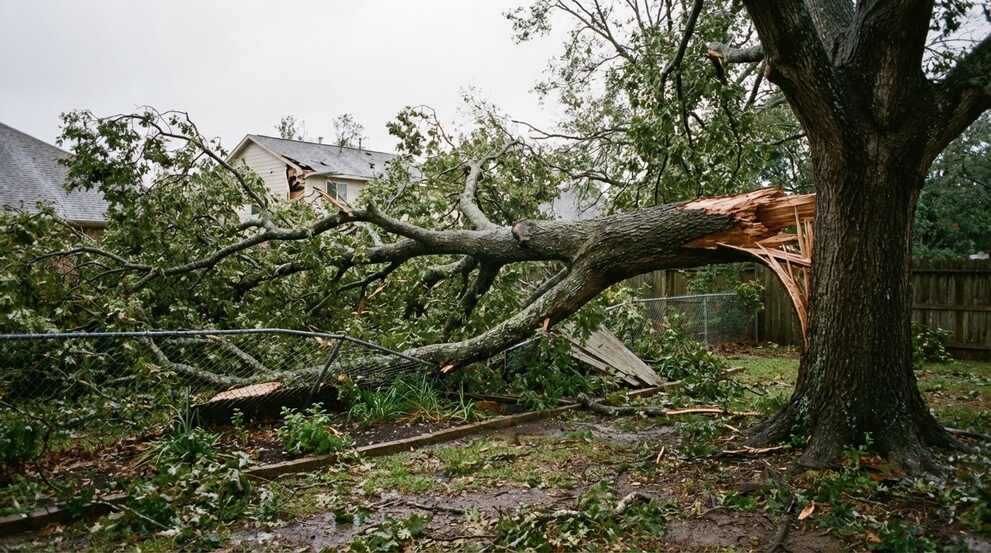
A sudden lean after a storm, especially if you see uplifted or cracked soil on the opposite side of the lean, is one of the most urgent warning signs of root plate failure. The root system has partially or fully released from the soil, and your tree may have very little holding it upright. Stay clear of the area and contact an arborist or emergency tree service in Austin as soon as possible.
Some situations call for an assessment even when your tree looks perfectly healthy.
High-Risk Situations That Call for an Arborist Assessment Even if the Tree Looks Fine
Your tree can look healthy from the ground and still carry elevated risk if something around it has changed. The better question is whether something has changed that affects your tree’s stability, the targets around it, or both.
- After trenching, grading, or root cutting near the tree. You may not see symptoms of root damage for months or even years, but your tree’s anchorage and health can suffer the whole time.
- Before construction, renovation, or major landscaping. A pre-work assessment documents your tree’s baseline condition and identifies root protection zones.
- When your soil stays saturated for extended periods. Prolonged wet conditions weaken your tree’s root anchorage and can trigger root decay.
- When you notice repeat limb drops, even small ones. Recurring branch failure often signals an underlying structural or health issue that warrants closer evaluation.
- When you recently purchased the home. A risk assessment establishes a baseline for trees you didn’t plant or maintain.
- When you manage common areas for an HOA, condo, or commercial property. Documentation supports liability reduction and defensible maintenance decisions.
- When you need documentation for insurance, a city permit process, or compliance. A written report from a qualified arborist gives you credible documentation you can hand to an insurer, a city office, or a board.
When Should You Schedule a Tree Risk Assessment After a Storm?
Schedule an assessment as soon as it’s safe to access your property, ideally within a few days of the storm. High winds can cause internal cracks, shift root plates, and weaken branch attachments without leaving obvious surface evidence. Even trees that kept all their limbs may have sustained structural damage that increases failure risk in the next storm.
Should You Get a Tree Risk Assessment Before Construction or Landscaping Work?
Yes. A risk assessment before construction, grading, or major landscaping protects both your trees and your investment. Excavation and heavy equipment can sever roots, compact soil, and change drainage patterns, all of which weaken trees in ways that may not become visible for one to three years. A pre-construction assessment documents your tree’s baseline condition and identifies the critical root zone so crews know where to avoid disturbance.
Why an Arborist Should Do the Assessment
When you’re making decisions about a tree near your home, you want those decisions based on a standardized process. A structured risk assessment follows a proven methodology, evaluates factors like structural integrity, target exposure, and site conditions, and produces a documented finding with clear recommendations.
That written report supports real-world decisions, from insurance conversations to HOA requirements to city permit processes. Protected and heritage tree rules can affect whether you’re allowed to remove a tree. An evaluation by a TRAQ qualified arborist in Austin, supported by clear written documentation, helps you make defensible choices and move through city permitting without surprises. You can learn more about our team and credentials on our arborist tree risk assessment page.
What Is ISA TRAQ, and Does It Matter?
ISA TRAQ stands for Tree Risk Assessment Qualification, a specialized credential from the International Society of Arboriculture for arborists trained in systematic risk evaluation. A TRAQ-qualified arborist uses a consistent, research-based methodology to evaluate likelihood of failure, likelihood of impact, and consequences rather than relying on gut instinct or visual impression alone. For you, that means the person evaluating your tree is following a repeatable, research-backed process.
What Standards Do Arborists Use for Tree Risk Assessments?
The primary industry standards are ANSI A300 Part 9, which governs tree risk assessment practices, and the ISA Best Management Practices companion publication. Together, these standards provide a consistent framework for how arborists evaluate risk, categorize findings, document results, and recommend mitigation. They are maintained by the Tree Care Industry Association (TCIA) and ISA, respectively. What that means for you is that the assessment follows a recognized professional framework, and the results hold up when you need to share them with an insurer, an HOA, or the city.
What Happens During a Tree Risk Assessment, and What You Receive
A risk assessment follows a structured sequence, covering the tree, its site, and its surroundings.
Your arborist starts by identifying what’s around the tree: your roof, walkways, play areas, utilities, and vehicles. They assess site conditions, including soil type, drainage, slope, and any recent changes to your landscape. The evaluation moves to the tree itself, starting at ground level with a root collar inspection for decay and girdling roots. From there, your arborist works up the trunk, checking for cracks, cavities, codominant stems, and bark anomalies.
The upper structure gets the same attention. Your arborist evaluates branch unions, canopy density and symmetry, deadwood, and overextended limbs. They may use sounding (tapping the trunk to detect hollows), probing, or binoculars to inspect the upper canopy. These techniques help evaluate areas that aren’t accessible from the ground. The entire assessment is documented with photos and notes throughout.
Here’s what you receive when the evaluation is complete:
- A risk rating for your tree based on the ISA framework
- Which specific defects or conditions are driving risk on your property
- Recommended mitigation actions, which may include pruning, tree cabling and bracing in Austin, ongoing monitoring, science-based diagnostics, or tree removal when risk is unacceptable
- A monitoring schedule so you know when to have the tree re-evaluated
- A written report with findings, photos, and recommendations that you can share with insurers, HOA boards, or city departments
What Do You Receive in a Tree Risk Assessment Report?
Your report gives you a written record you can act on and share. It may also identify when further tree healthcare diagnostics in Austin are needed to investigate canopy decline, root damage, decay, or other underlying health concerns. Use the report to support an insurance claim, present findings to an HOA board, satisfy a city permit requirement, or guide long-term maintenance decisions for your property.
Schedule an Arborist Tree Risk Assessment With Happy Tree Service of Austin
Happy Tree Service of Austin has ISA-certified arborists on staff, including TRAQ-qualified professionals. We take a science-first approach to every evaluation. We provide tree risk assessments for homeowners, HOAs, and property managers across Austin and Central Texas. Every assessment includes a thorough on-site evaluation, clear recommendations, and professional documentation you can rely on. When a tree presents an unacceptable level of risk, we can also recommend hazardous tree removal in Austin as the safest course of action. Call 512-212-0010 to schedule your tree risk assessment.